
Arrest Warrants in Acadia Parish
An arrest warrant is a written court order that allows officers to take someone into custody. Louisiana starts the process with a sworn affidavit and a magistrate's finding of probable cause under La. C.Cr.P. art. 202. The document itself must satisfy the content rules in La. C.Cr.P. art. 203. That is why a valid warrant names the offense and the issuing office rather than any verdict. Acadia Parish felony warrants come from the Fifteenth Judicial District Court, and the Clerk of Court criminal department files them. A city warrant belongs to whichever court signed it. Before calling anyone else, ask the issuing court which file you are dealing with. The distinction matters, because the wrong office will only send you elsewhere.
Probable Cause and the Acadia Parish Arrest Warrant
Article 202 demands an affidavit stating the nature, date, and place of the alleged offense. It identifies the offender if known and any injured person. The magistrate then weighs whether probable cause exists that an offense occurred and that the named person committed it. La. C.Cr.P. art. 496 adds another layer: an indictment carries a warrant unless the court issues a summons instead, and an information requires a probable-cause affidavit absent a summons. So two Acadia Parish felony cases can open with different paperwork.
What an Acadia Parish Arrest Warrant Contains
Article 203 spells out what the paper must carry. A record missing those parts is a question for the Acadia Parish court, not a search site.
| Caption | Issued in the name of the State of Louisiana |
|---|---|
| Issue date and place | When and where the magistrate signed it |
| Person | A name or a description that identifies the person |
| Offense | The charged offense |
| Command | An order to arrest and book the person |
| Signature | The magistrate's signature and title |
| Bail | A bond amount where the law allows one to be set |
A search warrant is a different animal. It authorizes a search of a described place or person in Acadia Parish, and it can stay sealed while an investigation runs.
Acadia Parish Arrest Warrant Filings at the Clerk
The Clerk of Court criminal department files formal charges from the Fifteenth Judicial District Attorney and handles felony charges in Acadia Parish. The office sits at 500 N.E. Court Circle in Crowley and keeps criminal records back to 1979. A public terminal is open Monday through Friday during office hours, and a history search costs $20. Keep in mind that a charge and a filed warrant are not the same thing. Ask the clerk whether a warrant was actually issued, which court signed it, and its current status. Write the case number down while you have the clerk on the line. Note: The Clerk criminal department page lists office hours, the criminal extension, and the felony filing role.
How Acadia Parish Arrest Warrants Are Served
Sheriff's deputies serve parish warrants and book people at parish facilities. City police work city cases inside their limits. City marshals handle municipal process in Rayne and Eunice, while constables serve papers for their justice of the peace courts. Arrests happen at traffic stops, at home, or through a voluntary surrender, and booking occurs wherever the arresting agency designates. The Acadia Parish Jail, the Criminal Justice Center, and the Detention Center each list a phone line. None of them publish bond-window hours, so call ahead before assuming a payment window is open.
Acadia Parish Arrest Warrant Service With LSP
Louisiana State Police and the sheriff's office sometimes work the same case. Official state police releases describe warrant service in Acadia Parish where local and state officers acted together, with the Fifteenth Judicial District Court issuing and the parish jail booking. That teamwork still does not create a public warrant search. The state police release page shows how an arrest gets announced publicly.
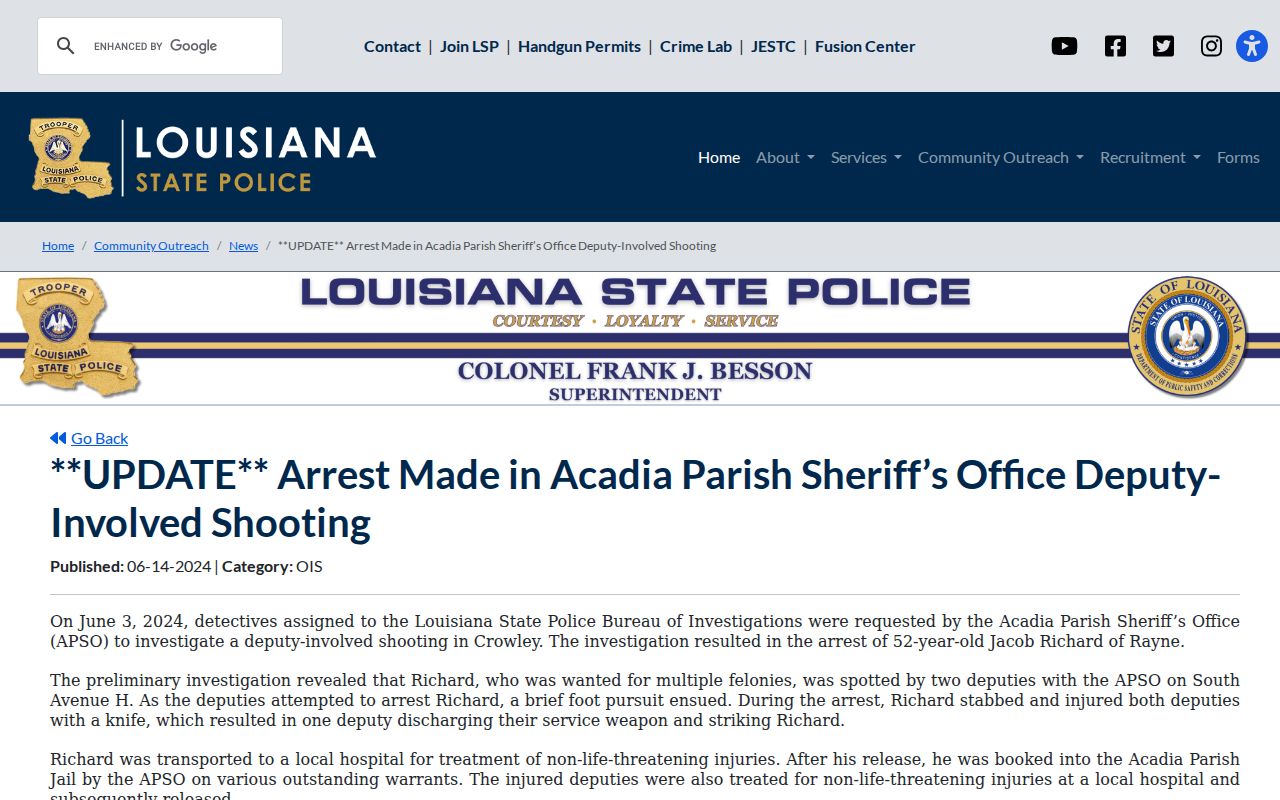
A press release never replaces the court record. Ask the Acadia Parish clerk for case status and the next setting.
Arrest Warrant vs Summons vs Bench Warrant
Three paper types can bring a person before an Acadia Parish court, and each starts from a different fact.
| Point | Arrest warrant | Summons | Bench warrant |
|---|---|---|---|
| How it starts | A sworn affidavit and probable cause | A charge filed with an order to appear | A missed or violated court obligation |
| Who signs it | A magistrate or judge | The court | The judge in the case |
| What happens next | The person is taken into custody | The person appears on a set date | The person is arrested on the warrant |
| What clears it | Arrest, bond, or recall | Appearance or a new order | A new date, payment, or recall |
A summons avoids an arrest only while the person obeys it.
A Federal Warrant Is a Different Process
Acadia Parish sits in the Western District of Louisiana. Federal arrest warrants come from federal judicial officers under federal criminal procedure, not the Fifteenth Judicial District Court or a city court. They generally do not surface in a public statewide name search. The federal court system runs its own dockets through the Western District of Louisiana. Federal agencies, not the sheriff's office, serve these warrants. A local jail may hold someone for another jurisdiction, but the local agency does not control that case. Before asking a local office for status, find out which court issued the paper.
What to Do If There's a Warrant for You
Confirm the Acadia Parish record first, then decide. Ask the court whether the warrant is active and what it allows: a payment, a new date, a recall motion, or a surrender. A lawyer can file a motion to recall or quash, arrange a walk-through, and explain whether bond is required.
Important: Talk with a lawyer before turning yourself in. A warrant can lead to arrest at a traffic stop, so timing and bond matter.
Never report to a jail on the word of an unverified third-party site. Instead, call the issuing court or the Acadia Parish sheriff and ask where to report and what to bring for the warrant.
Acadia Parish Arrest Warrant Surrender Steps
A voluntary surrender in Acadia Parish is scheduled, never a walk-in. Ask the court or the sheriff every question before the day arrives, since the answers shape how the surrender goes.
- Ask the court whether a walk-through or a set appearance is allowed.
- Ask the booking facility for the entrance, the hours, and the identification to bring.
- Confirm whether bond is preset, magistrate-set, or unavailable.
- Arrange counsel before the surrender when possible.
- Keep the booking paperwork, the release order, and any new court date.
Ask what happens after booking, too. A magistrate handles the first appearance, and posting bond does not end the underlying charge. Note: No Acadia Parish office runs an after-hours warrant window, so plan around regular business hours.